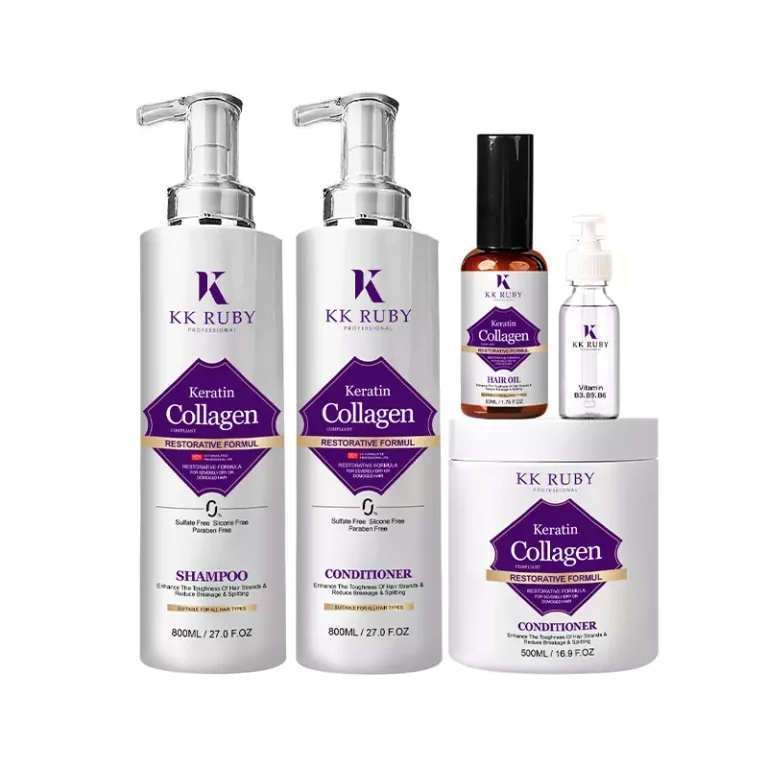
Most buyers start with a brochure and a price list. That sequence produces exactly the supplier you would expect: attractive presentation, unclear capability.
Vetting a private label hair care manufacturer works better in the opposite order. Decide what your product must be — shampoo, conditioner, mask, serum, bar — then test whether a candidate factory can produce that specific format at your volume, repeatedly, with documents you can hand to a customs agent or a retailer’s compliance team.
The checks below apply whether you are sourcing 3,000 units for a launch test or 300,000 units for a retail roll-out. The depth changes, the sequence does not.
Step 1: Request Four Documents Before Any Price Talk
Ask for these before a first call. A private label hair care manufacturer that has them ready on the same day is organized. One that needs a week is either new or outsourcing its filling line.
- GMPC or ISO 22716 certificate — check the certificate number, the scope wording, and the expiry date. A certificate covering “cosmetics” is broader than one covering only “skincare creams”.
- Sample batch record (BMR) from a comparable product — redact the client name, keep the process steps. You want to see batch size, mixing temperature, homogenization time, and QC release criteria.
- Preservative efficacy test (challenge test) for the formulation family you intend to buy. Water-based shampoo is a microbial risk category; this report is the single most important safety document for a leave-on or rinse-off hair product.
- MSDS and CoA templates for the finished goods, plus heavy-metal and microbial limit specifications.
For context on how these documents fit together across a supply chain, see Supply Chain Management for Hair Care Brands.
Step 2: Match the Filling Line to Your Package
Capability is line-specific. A private label hair care manufacturer that fills 500ml bottles well may have no sachet line, and bar shampoo requires pressing equipment that most liquid factories do not own.
| Format | What to verify | Typical constraint |
|---|---|---|
| Bottle (250–1000ml) | Filling accuracy, cap torque control, leak test protocol | Pump dispensers need a different capping head than flip-top caps |
| Tube (100–300ml) | Seal integrity after filling, crimp depth check | Thick masks and conditioners need heated filling |
| Sachet (5–10ml) | Per-sachet weight variance, film specification | Higher MOQ because of film printing set-up |
| Shampoo bar | Press tonnage, cure time, humidity-controlled curing room | Cannot share a line with liquid filling |
Ask for a per-run filling accuracy figure and the actual test method behind it. “We are very precise” is not a specification.
Step 3: Read the Formula, Not Just the Claims
A private label hair care manufacturer should be able to tell you the surfactant system in your shampoo and why it was chosen: an anionic primary surfactant for lather, an amphoteric or nonionic secondary to cut irritation, and a thickening or pearlizing system to hold viscosity.
Three questions separate a formulator from a reseller:
- Which preservative system is used, and what pH range does it need to stay effective?
- What is the viscosity target, at which temperature, on which spindle and speed?
- If we remove sulfates or add a silicone-free claim, what changes in stability and cost?
If the answers arrive as marketing language rather than parameters, you are talking to a trading company. That is not automatically disqualifying — but it changes who owns the risk when the second batch behaves differently from the first.
Additional background on raw material selection: What Are the Commonly Used Raw Materials for Shampoo OEM Manufacturing.
Step 4: Separate OEM from ODM Before You Talk MOQ
OEM means the buyer brings the formula or the brief; the factory manufactures to it. ODM means the buyer selects from the factory’s existing base formulae and customizes fragrance, color, packaging, and claims.
ODM shortens the timeline considerably because toxicology data, stability testing, and registration documentation usually already exist. OEM gives you exclusivity but adds development and testing cycles you will pay for.
Two practical consequences:
- ODM buyers should ask how many other clients use the same base formula. Exclusivity clauses exist but cost money.
- OEM buyers should ask who owns the formula on the invoice, and confirm the factory will sign a non-disclosure and non-compete covering the formula.
MOQ implications differ sharply between the two routes — our breakdown of MOQ thresholds for private label shampoo covers the packaging-driven cost steps.
Step 5: Test the Sample Process Itself
The sample is a product. The sample process is the data.
Request that the sample comes with: the formulation code, the batch size used, the filling date, and a stability note (at minimum 4-week accelerated at 40°C for shampoo and conditioner). Then compare the sample to the first bulk production run before releasing the balance of the order. A private label hair care manufacturer that cannot state the batch size behind your sample is not tracking its own process.
A useful test: ask for a second sample of the same formula, produced in a different batch size. Consistent viscosity, color, and odor across two batch sizes tells you the process is defined. Drift between them tells you the formula is being adjusted by hand.
Step 6: Factory Visit or Remote Audit — Twelve Questions
If you cannot travel, ask for a live video walkthrough with specific stops. Use the same twelve questions either way:
- Where are raw materials received, quarantined, and released?
- Which room houses the emulsification tank, and what are its minimum and maximum batch sizes?
- How is purified water produced and tested?
- What is the cleaning and changeover procedure between fragrance variants?
- Which QC tests are run in-house, and which are sent to third-party labs?
- How long are retain samples kept?
- What is the reject rate, and how are deviations documented?
- Which of your claims does the factory support with test data — sulfate-free, vegan, cruelty-free, hypoallergenic?
- Who writes the CPSR or safety report for the EU, and who registers CPNP?
- What are the packaging supplier lead times, and is packaging stock held on site?
- What happens if a batch fails QC after you have paid the deposit?
- Can we speak to a client who launched a similar product eighteen months ago?
Question 12 matters more than it looks. Factories with repeat regional clients have a commercial reason to fix problems. Factories that churn one-off orders have a reason to move on.
Cross-reference the answers with your own audit checklist: ISO Certified Cosmetic Factory in Guangzhou shows what a well-documented facility looks like, and GMP Certified Hair Care Manufacturer in China covers the certificate trail.
Step 7: Commercial Terms That Reveal Capability
Several terms tell you more about a supplier than the unit price:
- Payment structure — deposits above 50% on a first order usually indicate a cash-flow-driven operation rather than a capacity-driven one.
- Tooling ownership — if you pay for a bottle mould, confirm in writing who owns it and whether it can be transferred.
- Incoterms — an FOB quote tells you the factory controls inland logistics. Ex-works means you own the first mile.
- Regulatory support — a private label hair care manufacturer serving the EU or US should be able to describe the documents it provides for registration, not just the certificate it hangs on the wall.
Common Red Flags
- Certificates that cannot be verified on the issuing body’s register.
- No retain samples and no written deviation process.
- Sample quality noticeably better than the bulk shipment.
- Willingness to print any claim — organic, hypoallergenic, anti-hair-loss — without asking which market and which definition applies.
- A price list quoted per unit with no separation between formula, filling, packaging, and testing cost.
Selection Summary
Shortlist three candidates, request the four document types from each, then rank by documentation speed, line fit, and sample-to-bulk consistency. Price is a tiebreaker only after those three are equal — the cheapest unit cost is worth nothing if the second batch fails stability.
Our own line runs bottle, tube, and mask formats from 500 kg batch sizes upward, and we will share the BMR, challenge test, and QC specification for any base formula in our library before you commit to a spec. Review the available formats on the products page or send your brief through the service page.
FAQ
Do I need a private label hair care manufacturer in China to serve the US or EU market?
Not inherently — you need a manufacturer that can supply the documentation your market requires. For the EU that means a safety report and CPNP registration; for the US, label compliance and facility registration support where applicable.
How large should my first order be?
Start with the smallest volume that justifies the packaging set-up, run a stability check on the production batch, then reorder. Launching with a full container before validating the batch is the most expensive mistake in this category.
Can I buy finished goods and label them myself?
Yes, but check whether the manufacturer will release the CoA and the formulation code for a product they did not fill. Many regulatory questions land on whoever is named as the responsible person.
What should I send a shortlisted factory?
A one-page brief: target market, format, volume, packaging preference, claims you intend to make, and timeline. Everything in the vetting process above can be answered against that page.
Send us your brief and we will return a costed quote, MOQ, and lead time — contact us here.
For the full picture on this category, start with Shampoo OEM Manufacturer China: 2026 Sourcing Checklist.
Adjacent briefs worth reading together: Finding a Top Hair Care Manufacturer: How Brands Choose a Reliable OEM/ODM Partner, Finding the Right Partner: What to Look for in a Shampoo Supplier, Choosing the Right OEM Shampoo Manufacturer: A Strategic Guide for B2B Brands.
If you are comparing what a factory already produces, review our existing shampoo and scalp care formulations.