Most sourcing failures in hair care do not start with a bad formula. They start with a supplier that could not repeat the first batch, could not produce the documents a customs broker asked for on a Friday afternoon, or could not hold fill weight on the third run three months later.
A shampoo OEM manufacturer China importers can visit in person answers those questions in a single afternoon. The checklist below is the sequence we walk through when a brand asks us to benchmark a competing quotation, or when a buyer wants to know why their current supplier’s third batch has drifted from the sample they approved.
It works for a 5,000 pcs launch test and for a 200,000 pcs retail roll-out. The depth of the audit changes with volume. The order of the checks does not.
What a Shampoo OEM Manufacturer China Buyers Shortlist Must Prove
Start with legal capacity, not with price. China’s Cosmetics Supervision and Administration Regulation, in force since January 2021, requires every domestic cosmetic producer to hold a production licence with a defined scope, and to file each formulation family with the NMPA before the product leaves the factory. Ask for the licence scope in writing and confirm it covers the category you are buying. A factory licensed for leave-on skincare is not automatically licensed for rinse-off hair products, and the packaging claims you plan to print depend on which licence is in force.
Two practical tests separate a producer from a trader:
- Batch records with process parameters. A producer can show mixing temperature, homogenization time and QC release criteria from a comparable product, with the client name redacted. A trader forwards a laboratory report generated by somebody else.
- A fixed production address and an auditable line. If the only address you receive is a sales office, and the only photographs are stock renders, your purchase order is being placed with an intermediary who will sub-contract the filling.
Neither test requires a factory visit. Both require an answer within 48 hours, and that delay is itself a signal: disorganized documentation usually points to an outsourced filling line, which is where fill-weight drift and label mix-ups originate.
Formulation and Lab Capability: What the Factory Must Own
Formulation questions worth asking are technical. For a shampoo, the answers describe a system, not a hero ingredient:
- Primary surfactant — sodium laureth sulfate or sodium lauryl sulfate for lather and cost efficiency. Sulfate-free routes substitute sodium cocoyl isethionate, sodium cocoyl glutamate or coco-glucoside, which are milder but harder to thicken and more expensive per kilogram.
- Secondary surfactant — cocamidopropyl betaine or a nonionic co-surfactant to cut irritation and stabilize foam.
- Thickening system — sodium chloride works with sulfate systems but fails at low surfactant activity; PEG-150 distearate or polymeric thickeners hold viscosity in sulfate-free bases.
- Conditioning actives — polyquaternium-10, guar hydroxypropyltrimonium chloride or amodimethicone, chosen by whether the claim is softness, detangling or repair.
- Preservative system — sodium benzoate with potassium sorbate is effective below pH 5.5; phenoxyethanol covers a wider range. Either way, ask for the challenge test on the exact formula you are buying, not on a similar one.
Request targets in the quote, not adjectives: pH 5.0–5.5, viscosity 4,000–8,000 cP at 25 °C on a Brookfield RV spindle, and a stated lather volume method. A factory with its own lab can give those numbers from a pilot batch. Review what sits in that lab on our formulation and development page, and ask which of those steps would be repeated for your brief.
Packaging Formats, Fill Lines and MOQ in 2026
Filling accuracy protects your margin more than line speed does. A 500 ml bottle that overfills by 3% quietly gives away product on every pallet; one that underfills by 3% fails net-content rules in the destination market.
| Format | Typical capacity | Line constraint | MOQ driver |
|---|---|---|---|
| PET or HDPE bottle, pump or flip-top | 250 / 500 / 1000 ml | Capping head must match the closure; leak test after filling | Bottle and closure order, not the product |
| Tube | 100–300 ml | Thick masks and conditioners need heated filling | Tube printing set-up |
| Sachet | 5–10 ml | Per-sachet weight variance, film specification | Film printing cylinder |
| Shampoo bar | 60–100 g | Press tonnage plus humidity-controlled curing room | Cannot share a line with liquid filling |
Ask any shampoo OEM manufacturer China importers regularly reorder from for a per-run filling accuracy figure and the test method behind it. “We are precise” is not a specification; a tolerance in grams, sampled at the start, middle and end of a run, is.
Our published minimum is 5,000 pcs per SKU for standard bottle and tube formats, which keeps a first production run aligned with a launch test rather than a container load. Custom bottle moulds are quoted separately, tooled once for the buyer, and typically need 3–5 weeks before the first production batch. The trade-offs between these formats and order sizes are worked through in detail in this guide to custom shampoo minimum order quantities, and the ready formats are listed on our product range page.
Documentation for Importers: COA, MSDS, GMPC and ISO 22716
A shampoo OEM manufacturer China buyers rely on should hand over documents, not assurances. Build the file before you place the order, because a retailer’s compliance team will ask for it months later when the formulator and the sales contact have both changed.
- MSDS for the finished goods in GHS format, matching the formula version you bought.
- COA per batch, with the parameter set defined in advance: pH, viscosity, active content, appearance, odor.
- GMPC certificate and ISO 22716, with the scope wording and expiry date checked against the site you are buying from.
- Microbial and heavy-metal limits. For rinse-off hair products, the usual reference is ISO 17516, with typical ceilings of 1,000 cfu/g total aerobic microbial count, 100 cfu/g total yeast and mould, and absence of Staphylococcus aureus, Pseudomonas aeruginosa and Candida albicans in 1 g.
- Stability data — three months accelerated at 40 °C and 75% relative humidity, plus real-time data in the intended packaging.
- Free sale certificate, when your market requires it, legalized through the Chinese chamber of commerce and your consulate.
Registration duties sit with the importer or brand owner in most markets. In the EU, the Responsible Person notifies the product through CPNP and holds the product information file. In the US, cosmetic products no longer need pre-market approval, but MoCRA places facility registration and product listing obligations on the responsible party, together with adverse-event reporting. Our due diligence walk-through of GMP certified hair care manufacturing in China covers how to verify certificates that arrive as screenshots.
Nine Checks Before You Place a Purchase Order
Compare the shampoo OEM manufacturer China buyers keep on a second-source list against the one you are considering. The gaps usually appear in the last four items:
- Licence scope covers your category, and the licence number matches the production address on the quotation.
- A batch record from a comparable product, with process parameters visible.
- Challenge test on your formula family, not on the factory’s best-selling base.
- Fill accuracy tolerance stated in grams, with a sampling plan per run.
- Viscosity and pH targets written into the specification sheet, with the test method named.
- Label artwork reviewed against INCI ordering, net content rules and your market’s claim restrictions before printing.
- Stability protocol and its acceptance criteria agreed in writing.
- QC hold and release rules: sampling standard, acceptable quality level, and who signs the release.
- A named second filling partner for the format you sell most, agreed before you need it.
Item nine matters more than it looks. Contract production capacity tightens around peak season, and a brand with one filling partner absorbs the entire delay. The mechanics of splitting volume across two suppliers are covered in this guide to shampoo contract production.
OEM, ODM or Private Label: Which Route Fits Your Stage
The labels get used loosely, and the difference decides who owns the risk when the second batch behaves differently from the first.
| Model | Who owns the formula | Development time | Fits |
|---|---|---|---|
| Private label | Factory base formula, unchanged except fragrance and color | 3–4 weeks to first batch | Retailers testing a category, small brands |
| ODM | Factory base, customized actives, fragrance, texture and packaging | 4–6 weeks when the base exists | Brands wanting a differentiated product without owning R&D |
| OEM | Buyer’s formula or brief, developed and validated by the factory | 8–14 weeks including stability and challenge testing | Brands with a formulator, or a proprietary claim to protect |
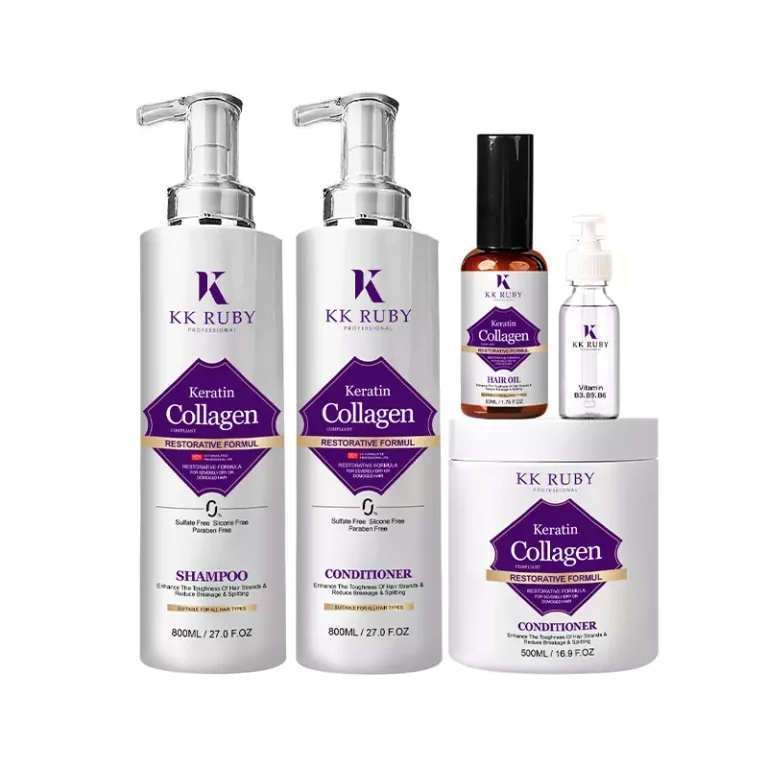
If your brief is proprietary, the shampoo OEM manufacturer China buyers pick for that route needs an in-house lab, a confidentiality clause that survives contract termination, and the discipline to keep your base off their standard price list. That combination is worth more than a two-point saving on unit cost. For a low-risk first order, start from an existing base — a set such as this keratin shampoo and conditioner set can be customized on fragrance, viscosity and packaging without a new formula development cycle. Our OEM and private label service page sets out which steps are included in each route.
FAQ: Importers’ Questions About Sourcing in China
How do I tell a factory from a trading company?
Ask three questions in one email: the cosmetics production licence number and its scope, the batch size of a recent comparable run, and the filling accuracy achieved on that run. A producer answers all three with documents. A trader answers one and redirects to price.
Can the factory handle registration in my market?
No cosmetics factory can register a product in your market on your behalf. What a competent factory supplies is the technical file: MSDS, COA, method of manufacture, stability and microbiological data, plus certificate legalization. The filing itself is done by your Responsible Person or your regulatory consultant.
What is a realistic timeline from brief to first shipment?
From an existing base formula, four to six weeks covers customization, sample approval and a production slot. A new formula adds eight to fourteen weeks of development, stability and challenge testing. Shipping then adds transit time and, for first-time imports, customs clearance on a new HS code.
How do I protect my formula and my packaging design?
Sign an NDA covering the formula, the packaging artwork and the tooling before you send a brief. For OEM work, specify that the formula stays exclusive and is not added to the factory’s catalogue. For packaging, register the design where your market allows it, and keep the mould invoice in your own name.
Next Step: Get a Costed Quote This Week
Send us your brief — format, capacity, target market and volume — and we will return MOQ, lead time and a sample plan in one business day. That is the shortest route to a shampoo OEM manufacturer China importers can audit before they commit, rather than one they have to re-audit after the first container. Use the contact form or send your specification directly to our team.
Adjacent briefs worth reading together: Beyond the Shelf: The Power of Custom Shampoo Processing, Choosing the Right OEM Shampoo Manufacturer: A Strategic Guide for B2B Brands, Custom Hair Care Formulation: When and How to Invest in Bespoke Products.
Related: The Global Hub: Why a China Shampoo Factory is Your Brand’s Best Asset.