Brand owners send us the same brief at the sample stage: should the repair line lead with collagen, keratin, or both? A collagen vs keratin shampoo decision is not about which protein is “better”. The two sit at different molecular weights, do different work on the hair shaft, and support different label claims. Pick the wrong lead protein and you will spend your testing budget defending a claim the formula cannot hold. This guide covers what each protein actually does in the base, how the choice rewrites your spec sheet, and what a factory in Guangzhou needs from you before it can quote.
What a Collagen vs Keratin Shampoo Comparison Really Measures
Most comparison articles rank the two proteins by marketing volume. Buyers need three measurable things instead: molecular weight, substantivity — how much protein stays on the fibre after rinsing — and the claim each one can legally support in your target market.
Keratin is the protein hair is already built from. That is why a keratin-led line reads as “restoring what is there”. Collagen is a structural protein from bovine, porcine or marine sources, and it reads as “conditioning and plumping”. Neither claim is free: both need a formula that deposits enough active to survive rinsing and drying.
Two practical consequences follow. First, the protein you name on the front label should be the one with the highest use level, or a reviewer can call the claim misleading. Second, if you want both names, budget for both actives — a token 0.1% of the second protein is a labelling cost with no performance behind it.
For the full sourcing context behind keratin-led lines, our China keratin nourishing and moisture shampoo sourcing guide walks through grades, documentation and supplier vetting.
Protein Size and Bond Repair: What Each One Does in the Base
When a brand asks for a bond repair keratin treatment claim, the conversation moves from marketing to chemistry quickly. Three variables decide whether the claim survives contact with a lab.
- Hydrolyzed keratin, 1–10 kDa — the smaller fractions are marketed for cortex penetration; larger fractions stay on the cuticle as a film that reduces friction and breakage. Ask your supplier for the molecular weight distribution, not just the INCI name.
- Hydrolyzed collagen, 2–5 kDa — mostly a film-former and humectant. It improves wet-comb and gives the slippery “repaired” feel consumers notice, but it does not rebuild disulfide bonds.
- Amino acid surfactants — sodium cocoyl glutamate and sodium lauroyl methyl isethionate are the usual mild, sulfate-free backbone for repair lines. Protein actives often sit badly with high-salt thickeners, so the surfactant system and the protein system have to be selected together.
- Cationic deposition polymer — guar hydroxypropyltrimonium chloride or polyquaternium-10 carries the anionic protein onto the negatively charged fibre. Without it, most of your protein goes down the drain.
A collagen amino acid shampoo and a keratin peptide shampoo therefore use the same deposition logic but different actives. The hydrolyzed keratin shampoo formulation you approve will also fix the pH window — repair lines are normally buffered around 4.5 to 5.5, which keeps the cuticle flat and the cationic charge active. Push the pH up for foam and you lose substantivity. The collagen vs keratin shampoo call therefore comes down to which active your deposition polymer is dosed to carry.
Background on how the repair category developed, and where the different protein systems fit, is in our keratin repair manufacturing overview.
Where the Collagen vs Keratin Shampoo Choice Changes Your Spec Sheet
The decision shows up in six lines of the technical sheet. Below is the shape we use when a brand has not yet chosen a lead protein.
| Spec item | Collagen-led line | Keratin-led line |
|---|---|---|
| Front-label claim | Conditioning, moisture, plumping | Repair, strength, bond support |
| Typical active use level | 0.5–2% hydrolyzed collagen | 0.5–2% hydrolyzed keratin |
| Film vs penetration | Film on cuticle, wet-comb | Mixed, size-dependent |
| pH window | 4.5–5.5 | 4.5–5.5 |
| Viscosity target | 5,000–12,000 cP | 5,000–12,000 cP |
| Preservation | Challenge-tested system | Challenge-tested system |
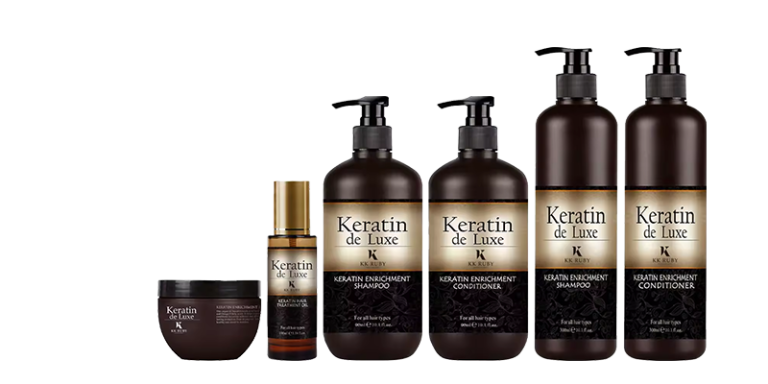
The honest reading of that table is that pH, viscosity and preservation do not change much — the claim, the active level and the evidence pack do. A finished set such as our collagen and keratin shampoo set exists precisely because many brands split the difference: collagen carries the moisture message, keratin carries the repair message, and the pair ships as one retail proposition.
If you only have budget for one claim, choose the one your market rewards. In the US and the EU, “repair” attracts more regulatory attention than “moisture”, so a keratin-led line needs a stronger evidence file. A collagen-led line is easier to substantiate but competes in a crowded conditioning shelf.
Claims, Substantiation and Label Rules by Market
The formula is the easy part. The claim file is where repair lines get pulled.
In the EU and UK, a shampoo is a cosmetic under Regulation 1223/2009. You need a Product Information File, a Cosmetic Product Safety Report signed by a qualified assessor, and a notification on CPNP before sale — with a separate UK notification if you sell there. Claim wording must be supported by evidence held on file.
In the US, the line between a cosmetic and a drug runs through intent. A shampoo that cleans and conditions is a cosmetic; the moment the label claims to treat hair loss or alter hair structure, you are in drug territory and need a different route. “Repair” sits close to that line, so the wording matters as much as the test data.
The evidence pack we prepare for repair lines usually includes:
- Accelerated stability data, typically 12 weeks at elevated temperature, run on the final pack
- Preservative efficacy testing to a recognised challenge-test method
- Heavy metal and microbial limits on the finished bulk
- A batch-specific COA and a current MSDS
- Deposition or combing data if a structural claim is used
Cosmetic factory formulas, protein grades and sample bases are listed on our formulations page if you want to compare a collagen-led base against a keratin-led one before committing.
Formats, MOQ and Packaging for a Repair Line
A collagen shampoo private label run is usually built around a single hero SKU plus one reinforcement format. Settle the collagen vs keratin shampoo question before you brief packaging, because the front-label claim is locked into the artwork. What actually drives your unit cost is not the protein — it is the bottle, the fill size and how many SKUs you split the order across.
| Format | Typical fill | Notes |
|---|---|---|
| PET bottle, disc-top | 250 ml / 400 ml / 500 ml | Lowest tooling, fastest to market |
| PET or HDPE, pump | 400 ml / 500 ml | Better perceived value for salon lines |
| Airless or tube | 200 ml / 250 ml | Best for thicker repair masks and treatments |
| Sachet | 10 ml / 15 ml | Low entry volume, good for sampling campaigns |
A few numbers to plan around. The station standard is a low MOQ of 5,000 pcs per SKU, so two SKUs means two 5,000-pc runs. Sample development usually lands in the 7 to 15 day range, and bulk production in the 25 to 35 day range once the formula and artwork are approved. Freight is quoted FOB or CIF depending on whether your forwarder handles the export leg.
Pair formats deliberately. A repair line built as keratin deep repair hair mask plus a keratin strengthening repair conditioner lets one shampoo carry the traffic and the other two carry margin — all three can share a protein system, which shortens development and testing. The wider range sits on our products page.
How to Vet a Repair-Line Manufacturing Partner
Any keratin smoothing treatment manufacturer can quote a price. Far fewer can hand you the evidence file on day one. Use these five checks before you sign.
- Ask for the molecular weight distribution of the protein actives they propose, not just the INCI list. A factory that cannot produce this is buying a blend and re-selling it.
- Ask which deposition polymer they use and at what level. If the answer is “we add protein and it works”, the claim is unproven.
- Request a sample batch record from a comparable repair SKU, with the batch’s COA. This is the fastest filter between a real plant and a trading office.
- Confirm in-house filling and the number of lines, then ask what happens if your forecast doubles. Capacity is the usual hidden constraint on a fast launch.
- Check GMPC and ISO 22716 certification scope — the certificate should cover the plant that will actually make your batch.
Our OEM service pages list the plant scope and the documentation we release with every quotation. For the conditioner side of a repair pair, the sourcing logic is set out in our keratin conditioner private label guide, and the equivalent frame for smoothing treatments is in the botox hair treatment private label guide.
FAQ: Collagen vs Keratin Shampoo Buying Questions
Can one shampoo carry both collagen and keratin on the label?
Yes, and it is a common spec. Just make sure both actives are at meaningful levels and that the deposition polymer is dosed for the combined load, or the second protein is decoration on the ingredient list.
Which is easier to launch in the EU?
Collagen-led lines are simpler to substantiate because the claims are conditioning claims. A keratin-led line is still workable, but you will need the evidence file ready before the PIF is signed.
Does protein size really matter, or is it supplier talk?
It matters for the claim. Small fractions support penetration language; large fractions support film and combing language. Match the wording to the fraction you buy, and the claim stops being a risk.
How many SKUs should the first run include?
Start with one hero shampoo. Add a mask or conditioner on the second run once the first batch has sold through, because each extra SKU multiplies MOQ, artwork and stability testing.
Tell us your target market and volume, and we will confirm the protein system, the claim wording your label can carry, and a costed quote. Send us your brief for a collagen vs keratin shampoo project and we will come back with a sample plan within one business day — contact our team to start.