China keratin nourishing & moisture shampoo has moved from a salon-only treatment to a mainstream shelf category, and procurement teams are taking notice. The appeal is easy to explain: damaged hair is usually both dry and brittle, so a single product that pairs a repair protein with a hydration system answers two consumer complaints at once. The difficulty is that the formula must hold that balance through production, transit, and six months on a retail shelf. This guide explains what a qualified manufacturer should document, what to verify before signing an OEM or private label agreement, and how we structure such programs at our Guangzhou factory.
The Dual Claim That Drives the Category
Demand for a China keratin nourishing & moisture shampoo has grown because the claim pairs two benefits shoppers already understand. Keratin stands for strength and repair; moisture stands for softness and manageability. Brands that put both on the front label appeal to a wide audience: consumers with color-treated, heat-styled, or environmentally damaged hair. The category also benefits from professional endorsement, because stylists frequently recommend a protein-and-hydration routine after chemical services.
The opportunity, however, comes with a compliance obligation. Retailers and regulators in the EU, the United States, and ASEAN increasingly ask for substantiation when a product makes repair or moisturizing claims. A manufacturer that documents the active keratin concentration, the humectant level, and the test methods behind both claims protects the buyer from a compliance problem later.
Formulation Science: Keeping Keratin and Moisture in Balance
Keratin in a rinse-off shampoo is typically added as hydrolyzed keratin, a protein broken into smaller fragments so it can deposit on the hair surface and penetrate damaged cuticles to a limited degree. One term worth knowing: a humectant is a moisture-binding ingredient that draws water into the hair fiber and slows evaporation; glycerin, panthenol, and propanediol are common examples. The formula’s job is to combine the two systems without letting either dominate.
Two variables determine whether that balance holds. First, the molecular weight of the hydrolyzed keratin: grades between 500 and 2,000 Daltons balance deposition with easy rinsing, while heavier grades leave residue and lighter grades rinse away. Second, the ratio of protein to humectant relative to the hair’s porosity. Low-porosity hair resists moisture absorption and becomes stiff under heavy protein, a condition stylists call protein overload. A well-designed formula adjusts the protein level, adds a lightweight conditioning polymer, and uses a surfactant system that cleanses without stripping the deposited layer.
Stability is where sourcing mistakes happen. Protein interacts with anionic surfactants, and moisture-active ingredients can change viscosity over time. A qualified manufacturer runs a three-month accelerated stability study at 40 degrees C and 75% relative humidity, plus freeze-thaw cycles, on every protein shampoo formula before production. Raw data stays available to the buyer under NDA.
Why Source from a China Manufacturer
Sourcing a China keratin nourishing & moisture shampoo is a cost-and-capability decision. Chinese contract manufacturers operate at a scale few Western facilities can match, with surfactant production, packaging conversion, and filling lines under one roof. That vertical structure lowers the landed cost per unit and shortens the supply chain for bottles, pumps, and labels. For a brand launching at a competitive retail price, the unit economics are usually decisive.
Scale is only an advantage if quality controls are in place, which is why buyer evaluation matters more in this market than in almost any other. A serious supplier operates a GMPC facility, documents incoming raw material inspection, runs batch-specific testing, and can show production records. The question is not whether Chinese factories can make a keratin shampoo; it is whether a specific factory can make yours to specification, batch after batch.
Evaluating a Keratin and Moisture Shampoo Manufacturer
When you evaluate a China keratin nourishing & moisture shampoo manufacturer, focus on four areas: raw material sourcing, in-house R&D capability, test documentation, and packaging options. Ask which supplier provides the hydrolyzed keratin, whether a certificate of analysis accompanies every raw material lot, and whether the factory can switch molecular weight grades to hit a target feel. In-house R&D matters because protein formulas usually need adjustment before they meet a brand’s viscosity, foam, and fragrance brief. Our formulation library holds more than 5,000 formulas, and our in-house R&D team develops protein shampoos rather than reselling a generic base.
Documentation is the second gate. A dependable partner provides batch-specific certificates of analysis, stability study reports, and third-party test reports from laboratories accredited to ISO 17025. These reports matter because retailers in the EU, North America, and ASEAN ask for them during product registration or shelf review. We provide third-party test reports as part of the project package, and we sign NDAs before sharing formulation details.
Packaging is the third gate. A keratin and moisture shampoo with a premium positioning needs a bottle, a pump, and a label that match the formula’s viscosity and the brand’s shelf image. Customizable packaging options include bottle shape, cap type, film label versus shrink sleeve, and decoration methods such as screen printing and hot stamping. Our engineering team coordinates packaging selection with formula development so both are finalized together, shortening the timeline from brief to production.
What We Provide at Our Guangzhou Factory
We have operated as an OEM and private label manufacturer in Guangzhou for 16 years. Our 50,000-square-meter GMPC facility houses more than 100 production lines with a daily output of 500,000 units, and our standard MOQ is 5,000 pieces per SKU, with tiered pricing beginning above 20,000 pieces. For a keratin and moisture shampoo launch, a custom formula typically takes 8 to 10 weeks; an existing formula from our library can be production-ready within 3 to 4 weeks. Free samples are available for evaluation, and our compliance team supports cosmetic notification for the EU, FDA registration for the United States, and other market requirements as part of the turnkey service.
We have developed China keratin nourishing & moisture shampoo programs for brands in Europe, North America, and Southeast Asia. A recent project illustrates the workflow. A U.S. e-commerce brand wanted a repair-and-hydration shampoo positioned between mass-market and professional price points. Our R&D team selected a hydrolyzed keratin grade near 800 Daltons, combined it with panthenol and glycerin as humectants, and balanced the formula with a lightweight conditioning polymer. We ran the three-month accelerated stability study, adjusted the preservative system once, and issued a batch-specific certificate of analysis. The brand received third-party test reports, chose a custom bottle with a pump from our packaging catalog, and placed a first order of 5,000 units. The second order, placed eight weeks later, moved to tiered pricing.
Procurement Checklist Before You Sign
Before you commit to a keratin and moisture shampoo program, confirm five items in writing: the active keratin concentration and molecular weight grade, the humectant system and its level, the accelerated stability study results, the batch-specific certificate of analysis policy, and the third-party test reports available for your destination market. Clarify how the manufacturer handles formula changes, retesting, and artwork updates, and ask for references from brands in your channel.
Also confirm the supply chain for protein and humectant raw materials. A factory that buys on price alone will produce inconsistent viscosity and feel from lot to lot. A supplier that locks the raw material specification, keeps two qualified sources, and documents incoming inspection gives you the repeatability your brand needs across reorders.
Keratin Lines We Manufacture for Private Label
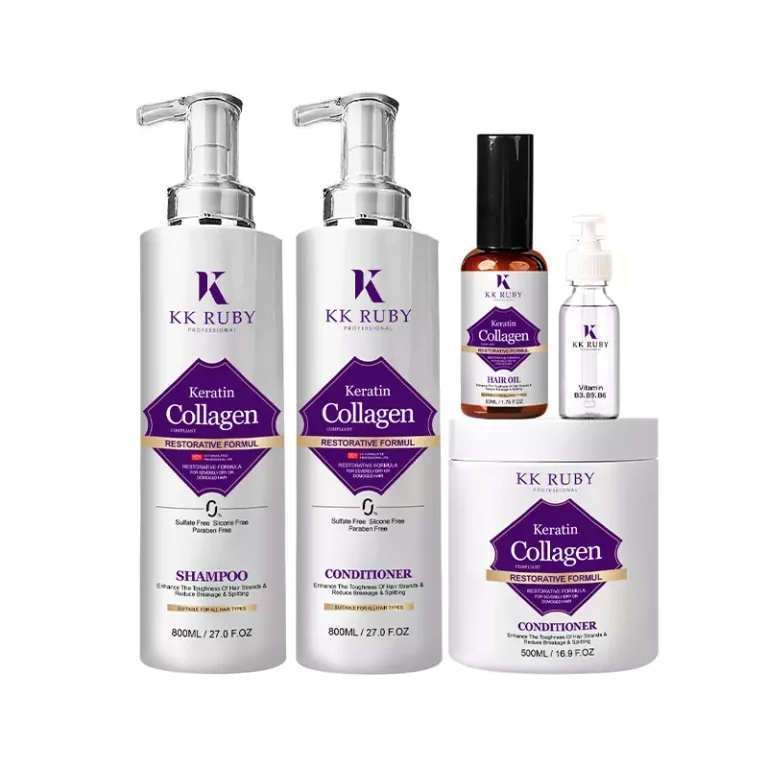
Keratin ranges sell as systems, not single bottles. Buyers who order one shampoo usually return for the matched conditioner or a repair mask once the first container clears customs. The keratin products we produce most are a collagen keratin shampoo set, keratin shampoo and conditioner set, syringe keratin shampoo set and keratin strengthening conditioner, each using hydrolysed keratin at the molecular weight appropriate to its format. Every item starts at 5,000 pcs per SKU with custom formula, fragrance and packaging, on factory wholesale terms for brands, distributors and importers only.
Frequently Asked Questions
1. How does a keratin nourishing & moisture shampoo differ from a standard protein shampoo?
A standard protein shampoo focuses on keratin deposition for strength, while a nourishing and moisture formula pairs the protein with humectants such as glycerin and panthenol so the hair is hydrated at the same time. The combination matters for dry, damaged hair, where protein alone can leave the fiber stiff.
2. What is the MOQ for a private label keratin and moisture shampoo?
Our standard MOQ is 5,000 pieces per SKU, which covers active ingredient procurement, stability testing, and line setup. Tiered pricing begins above 20,000 pieces. We recommend requesting free samples first so your team can evaluate the formula and packaging before committing to a production order.
3. How long does it take to develop a custom keratin and moisture shampoo?
A custom formula typically takes 8 to 10 weeks from brief to production-ready, including stability testing that runs in parallel with packaging development. If you adopt an existing formula from our library of more than 5,000 formulations, the timeline shortens to 3 to 4 weeks.
4. Do you provide third-party test reports for keratin and moisture claims?
Yes. Every project includes stability testing, microbiological testing, and a batch-specific certificate of analysis. For marketing claims such as repair or moisturizing, we coordinate third-party test reports from laboratories accredited to ISO 17025 and share them as part of the project package.
5. Can you customize the packaging for a keratin shampoo line?
Yes. Customizable packaging options include bottle shape, cap and pump selection, film label or shrink sleeve, and decoration methods such as screen printing and hot stamping. Our engineering team coordinates packaging with formula development so both are finalized together.
Contact us today to request free samples and a customized quotation for your next hair care product line.
Adjacent briefs worth reading together: The Keratin Revolution: A Comprehensive Guide to Modern Hair Repair and Manufacturing.
If you are comparing what a factory already produces, review our private label hair care product range.