Conditioner is the product that decides whether a brand gets a repeat order. Shampoo cleans; conditioner is what the customer feels in the shower on day three. That is why choosing a hair conditioner manufacturer private label partner deserves more scrutiny than the shampoo line that usually comes first in the conversation.
Most brands start with the bottle and the price per unit. Then they discover, two months into production, that the base separates in summer transit, that the pump will not push a 12,000 cP emulsion, or that the “repair” claim on the label cannot be supported in the European Union without test data.
This guide covers what a conditioner factory actually supplies, which formulation decisions you are buying, how fill format changes your MOQ, and the five checks that separate a real plant from a trading office.
What a Hair Conditioner Manufacturer Private Label Partner Delivers
A private label conditioner is not a shampoo base with extra thickener. The conditioning system is a separate chemistry: cationic surfactants that adsorb onto negatively charged hair, fatty alcohols that build body and hold the emulsion, and a preservative package chosen to survive a pH of 4 rather than a pH of 6.
Before price talk, ask a candidate for the batch record of a conditioner they filled in the last thirty days. You want to see: batch size, emulsion temperature curve, homogenisation time, viscosity reading, pH reading, fill weight samples, and the name of the person who released it. A factory that cannot produce that document within one working day is usually buying finished goods from someone else.
Two ownership questions also belong in the first call. Who holds the formula IP — you or the factory? And will they sign an exclusivity clause covering the formula and the pack for your market? On a private label base the answer is normally yes on exclusivity and shared on IP, which is acceptable as long as it is written down.
Conditioner Formulation Systems: What the Base Actually Contains
The base is where your unit cost and your marketing claims both come from. Four families of raw material do the work.
- Cationic conditioning agents — behentrimonium methosulfate (usually supplied as BTMS-50 with cetyl alcohol) gives smooth, low-irritation conditioning and is the default for premium lines. Cetrimonium chloride costs less and conditions harder, but at higher use levels it can feel heavy on fine hair. Amodimethicone is specified when the target market is chemically damaged or bleached hair.
- Fatty alcohols — cetyl and stearyl alcohol are the body-builders. They are not the drying type of alcohol consumers read about on labels; they are waxy solids that give the cream its structure and stop oil and water separating.
- Actives — hydrolysed keratin, hydrolysed silk, panthenol, argan oil, ceramides and plant extracts. Ask for the specification sheet, not just the trade name. Hydrolysed keratin below roughly 1,000 Da penetrates the cuticle; higher molecular weights mostly coat it. That difference decides whether you can use “penetrating repair” in your copy.
- Preservative system — chosen against the finished pH and water activity, then validated by a challenge test. This is the single most common cause of recalled conditioner batches.
Two process numbers matter more than the ingredient list. pH should sit between 3.5 and 5.0 — lower closes the cuticle and improves shine, but drags the preservative out of its working range. Viscosity is usually targeted between 3,000 and 15,000 cP depending on pack: a 250 ml squeeze bottle and a 200 ml tube need different rheology even with the same formula. Our formulations page lists the base systems currently available for adaptation.
A practical warning: cationic conditioners and anionic shampoo bases must never share a transfer line without a validated clean-down. Residual anionic surfactant kills the emulsion and you get a thin, curdling batch. If a factory runs shampoo and conditioner on one filling line, ask for the changeover procedure in writing. This is also the question that separates a hair conditioner manufacturer private label operation from a shampoo plant that added conditioner as a side line.
Bulk Formats, Fill Lines and MOQ Ranges
Conditioner sells in more pack shapes than shampoo, and the pack is what usually moves your MOQ. A 10 ml sachet and a 1,000 ml salon bottle carry very different setup costs, even when the formula is identical.
| Format | Typical pack | Fill volume | Line type | MOQ per SKU |
|---|---|---|---|---|
| Retail bottle | PET or HDPE, disc-top or pump | 250 ml / 500 ml / 1,000 ml | Inline piston filler | From 5,000 pcs |
| Tube | Laminated ABL/PBL, flip-top seal | 200 ml / 300 ml | Tube filling + crimp | From 5,000 pcs |
| Sachet / sample | Foil laminate, 3-side seal | 10 ml / 20 ml | Vertical form-fill-seal | Higher count, lower unit cost |
| Salon / refill | HDPE jerry can | 4 L / 5 L | Semi-automatic gravity filler | By weight, not by unit |
The site standard for a hair conditioner manufacturer private label project is 5,000 pcs per SKU, which applies per formula and per pack. Five thousand units across three variants of the same formula usually costs less than five thousand units of one variant, because the emulsion is batched once. A 500 L or 1,000 L vacuum emulsifying tank with in-line homogeniser covers the 5,000–50,000 pcs range comfortably; below that, artisan-scale mixing gives worse viscosity consistency than most brands expect.
Fill accuracy is the number to test, not to read. Ask for a fill weight control chart from the last production run: ±1% on a 500 ml fill is normal on a calibrated piston filler, and 3% is a sign of worn seals. On a 200,000 pcs order, a 2% overfill is real money.
Certifications and Compliance by Target Market
Documentation is where private label conditioner projects stall at the port. The core set the factory should issue without being chased:
- GMPC and ISO 22716 certificates, with the scope covering leave-on emulsions, not just liquids.
- MSDS for each finished formula, in the format your freight forwarder’s carrier accepts.
- COA per batch — appearance, pH, viscosity, microbial count, fill weight.
- Stability data — three months at 45 °C plus freeze-thaw cycles, run on the exact pack you are buying, not on a glass beaker.
- Preservative efficacy test — ISO 11930 or the older CTFA method, reported against the finished pH.
- INCI declaration and allergen list in the order required by your label size.
For the European Union, the responsible person files the CPNP notification and needs your formula disclosure and safety assessment; a factory that has never supported a CPNP filing will slow that process down. In the United States, cosmetic facility registration and product listing are voluntary under the FDA framework, but retailers and Amazon frequently request them anyway, so ask whether the plant is already registered before you promise a launch date. Claims travel further than certificates: “reduces breakage” needs instrumental test data, while “conditions and detangles” describes what a cationic system does and is defensible from the formula. More detail on what the audit paperwork should contain is on our service page.
How to Shortlist a Hair Conditioner Manufacturer Private Label Supplier
Run these five checks in order. A supplier that fails check two rarely improves later.
- Batch traceability — pick any SKU they produced last quarter and ask to see its full record. If the answer is a summary sheet, the records are reconstructed.
- Formula control — ask who weighs the raw materials and whether weigh-outs are witnessed. One-person, unwitnessed weighing is where viscosity drift comes from.
- Line changeover — get the clean-down validation between anionic shampoo and cationic conditioner in writing.
- Sample discipline — request a 500 g lab sample plus two pilot batches. Compare viscosity and pH across all three; they should match within your agreed tolerance.
- Commercial transparency — a costed quote that lists formula, pack, filling, labelling, testing and freight separately. If it is one lump sum, you cannot negotiate any single line later.
Two earlier guides are worth reading before your first call: how to vet a partner before signing, and a comparison of conditioner plant cost against contract production. For a formula-level walkthrough of a specific system, the keratin conditioner sourcing guide shows what to demand at sample stage, and the organic conditioner verification checklist covers certification wording in detail.
OEM vs ODM for Conditioner Lines
The choice is about time to shelf and how much of the product you own.
| OEM (your formula) | ODM (factory base) | |
|---|---|---|
| Development time | 4–8 weeks inc. stability start | 1–2 weeks to sample |
| Development cost | Formulation fee, tests | Usually absorbed in unit price |
| Formula IP | Yours, with exclusivity | Factory’s; exclusivity negotiable |
| Best fit | Established brands, differentiated claims | Launch tests, marketplace sellers, tight timelines |
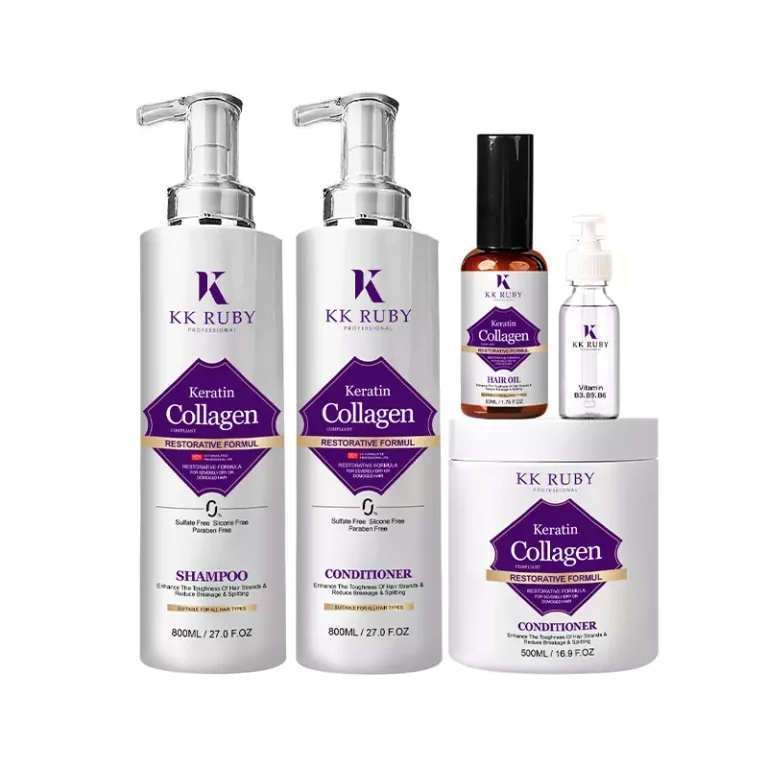
ODM works when you need to test a market with 5,000 pcs and no formulation budget. OEM pays back once your conditioner is the reason customers reorder — at that point the base is an asset and you want it documented as yours. The product range page shows which conditioner bases are already documented to OEM standard; sets such as the keratin conditioner pair are the fastest route to a shelf-ready duo. If you are building a shampoo-and-conditioner pair, mask and conditioner contract manufacturing shares the same filling line and packaging logic.
Conditioner Manufacturing FAQ
What is the minimum order for a private label conditioner?
The site standard is 5,000 pcs per SKU, applied per formula and per pack. Sample and sachet formats can start lower in unit volume but carry higher setup cost per piece. Any hair conditioner manufacturer private label supplier quoting well under that figure is usually quoting a stock base in your own packaging.
Can I use my own fragrance and my own bottle?
Yes. Fragrance must be supplied with its IFRA certificate and allergen declaration, and the bottle must be tested with the finished emulsion — some pumps cavitate above 10,000 cP.
How long does the first batch take?
Plan on four to eight weeks from approved brief to first production batch. Stability testing runs in parallel and is the usual critical path, not filling.
Will the factory help with EU or US compliance paperwork?
A plant working on export orders should provide MSDS, COA, stability and challenge test reports, and support CPNP or retailer documentation requests with formula disclosure under NDA.
Next Step: Request Your Conditioner Sample Batch
Send your brief — target market, pack, fill volume and the conditioning feel you want — and we will come back with a formula direction, a MOQ per SKU and a costed quote broken down by line item. If you already have a competing quotation from another hair conditioner manufacturer private label supplier, include it: we will benchmark it line by line and tell you which items look under-specified. Use the contact form or submit your request and a formulator will reply within one business day. Brands scaling from the shampoo OEM sourcing checklist typically add the conditioner SKU in the same production window to save on freight and testing.
Adjacent briefs worth reading together: Custom Conditioner Formula Development: A Guide for B2B Procurement Decision Makers, Hair Mask Manufacturer Private Label: Bulk, Sachet & Tube, Looking for a Reliable Hair Care Manufacturer? The Ultimate Guide to Shampoo & Conditi.